
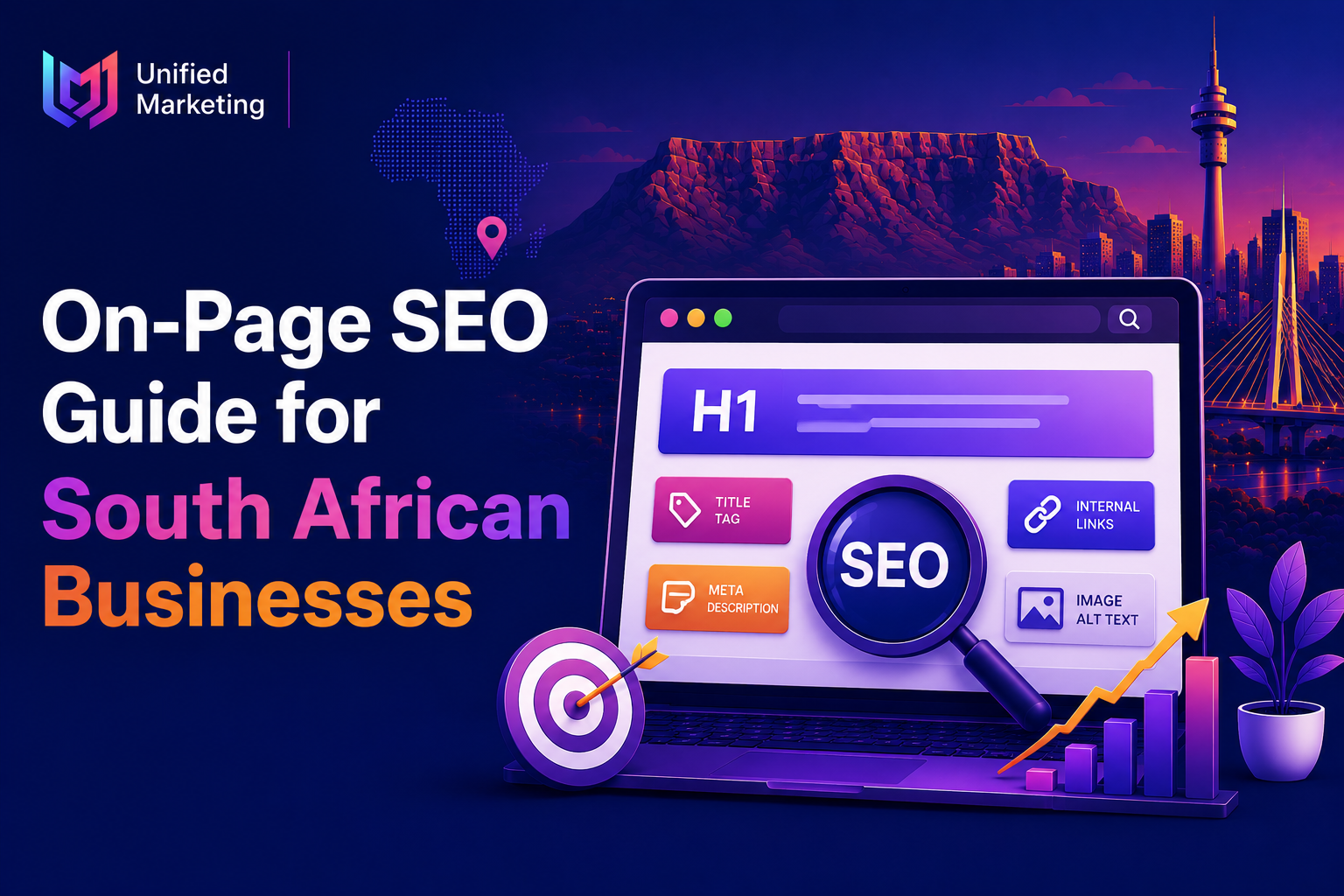
On-page SEO is the part of search optimisation you have the most direct control over. Unlike technical SEO or link building, on-page elements — your titles, headings, content, and internal links — can be improved today, by anyone, without needing developer access or external tools. This guide walks South African business owners through exactly how to optimise every page on their website.
What Is On-Page SEO?
On-page SEO refers to all the optimisations made directly on a webpage to help it rank higher in Google and earn more relevant traffic. This includes your page titles, meta descriptions, heading structure, keyword usage within content, internal linking, and image optimisation — every element Google reads when deciding what your page is about and how relevant it is to a search query.
1. SEO Title Tags
Your title tag is the clickable headline that appears in Google search results. It is one of the strongest on-page ranking signals and directly affects your click-through rate.
Best practices for South African businesses:
- Keep titles under 60 characters to avoid truncation in search results
- Include your primary keyword naturally, ideally near the beginning
- Add your city if you serve a specific area (e.g. “Cape Town” or “Johannesburg”)
- Make every title unique — never duplicate titles across pages
2. Meta Descriptions
While meta descriptions are not a direct ranking factor, they significantly influence whether someone clicks your result over a competitor’s in Google search. A compelling meta description acts as free advertising copy for every page on your website.
Best practices:
- Keep descriptions between 140-155 characters
- Include your primary keyword naturally
- Add a clear call to action or benefit statement
- Write uniquely for every page — never leave this field blank
3. Heading Structure (H1, H2, H3)
Proper heading structure helps Google understand your content hierarchy and makes your page easier for visitors to scan and read.
Heading rules every South African website should follow:
- Use exactly one H1 per page, including your primary keyword
- Break content into logical sections using H2 headings
- Use H3 headings for sub-points within each H2 section
- Never skip heading levels (e.g. jumping from H1 directly to H3)
4. Keyword Placement Within Content
Modern SEO is not about stuffing keywords repeatedly — Google’s algorithms are sophisticated enough to understand topic relevance through natural language. Focus on using your primary keyword naturally within the first 100 words, in at least one H2, and a handful of times throughout the content where it reads naturally.
5. Internal Linking
Internal links — links from one page on your website to another — help Google understand your site structure and distribute ranking authority across your pages. They also keep visitors engaged longer by guiding them to related content, like the way this guide links to our SEO services page and our SEO audit service.
Internal linking best practices:
- Use descriptive, keyword-relevant anchor text (not “click here”)
- Link to relevant pages naturally within your content
- Aim for at least 3-5 internal links per blog post or service page
- Avoid linking the same anchor text to multiple different pages
6. Image Optimisation
Images affect both page speed and SEO. Every image should be compressed for fast loading and include descriptive alt text — which helps Google understand the image content and improves accessibility for visually impaired users.
On-Page SEO Checklist Summary
| Element | What to Check |
| Title Tag | Under 60 characters, includes keyword, unique per page |
| Meta Description | 140-155 characters, includes keyword and CTA |
| H1 Tag | One per page, includes primary keyword |
| H2/H3 Structure | Logical hierarchy, secondary keywords included |
| Content | Keyword in first 100 words, natural usage throughout |
| Internal Links | 3-5 relevant links with descriptive anchor text |
| Images | Compressed, descriptive alt text on every image |
| URL Structure | Clean, short, includes target keyword if possible |
Common On-Page SEO Mistakes South African Websites Make
- Leaving meta descriptions blank, letting Google auto-generate them
- Using the same H1 across multiple service pages
- Keyword stuffing instead of natural language usage
- No internal links connecting related pages
- Generic image file names with no alt text (e.g. “IMG_4521.jpg”)
Frequently Asked Questions
How is on-page SEO different from technical SEO?
On-page SEO refers to optimisations within the actual content and structure of a page — titles, headings, keyword usage, and internal links. Technical SEO refers to the underlying infrastructure that affects how Google crawls and processes your entire website — site speed, mobile responsiveness, crawlability, and indexation. Both work together: technical SEO ensures Google can access your pages, while on-page SEO ensures Google understands and ranks them correctly once accessed.
How many keywords should I target per page?
We recommend focusing each page around one primary keyword with 2-4 closely related secondary keywords woven naturally throughout the content. Trying to target too many unrelated keywords on a single page dilutes your relevance signal to Google and typically results in the page ranking poorly for all of them rather than well for any single one.
Does keyword density still matter for on-page SEO in 2026?
Modern Google algorithms focus far more on natural language understanding and topical relevance than rigid keyword density percentages. Rather than counting how many times a keyword appears, focus on covering the topic comprehensively and naturally — using your keyword and related terms wherever they genuinely fit, without forcing repetition that reads awkwardly to human visitors.
Can I optimise on-page SEO myself, or do I need an SEO professional?
Basic on-page SEO — writing good titles, meta descriptions, and using proper heading structure — is genuinely achievable for most business owners following a checklist like this one. More advanced on-page strategy, including comprehensive keyword research, content depth analysis, and internal linking architecture across a large website, typically benefits from professional SEO expertise.
How often should I review and update my on-page SEO?
We recommend reviewing your highest-traffic and highest-value pages at least every 6 months, checking whether titles and content still accurately reflect current keyword opportunities and search intent. Pages that have dropped in rankings or traffic should be reviewed sooner, as this often signals that competitors have published more comprehensive or better-optimised content.
Final Thoughts
On-page SEO is the most accessible part of search optimisation for any South African business owner to start improving today. Work through each page on your website systematically using this checklist, and you’ll give Google — and your potential customers — exactly what they need to find and choose your business.
“Want a professional review of your on-page SEO before you spend hours doing it yourself? Get a free audit highlighting your biggest opportunities.”
